
In March 2026, the New Zealand Herald published an article about the Government’s ban on new puberty blocker prescriptions for gender-dysphoric young people. The article was sympathetic in tone and drew on a personal account from a guardian who had raised a young person on puberty blockers. That is a legitimate form of journalism. What followed, however, is the subject of this post.
I lodged a formal complaint with the New Zealand Media Council on two main grounds: that the article stated as plain fact a claim about puberty blockers that is not supported by the evidence, and that it published a statement about suicide that breaches New Zealand’s own national guidelines on responsible reporting. The documents relating to this process are linked below.
The Reversibility Claim
The original article contained the sentence: “Puberty blockers are reversible.” This was presented without attribution, qualification, or any indication that it was contested. It is not an accurate statement of the current evidence.
The 2024 Cass Review was an independent review commissioned by NHS England and cited in the very same article as the basis for the Government’s ban. The review, led by Baroness Dr Hilary Cass, found that reversibility is undemonstrated across multiple domains. On bone health, it found that bone density is compromised during puberty suppression and that much longer-term follow-up is needed to determine whether full recovery occurs in adulthood. On brain development, it found that brain maturation may be temporarily or permanently disrupted. On fertility, the 2025 US Department of Health and Human Services review found that where puberty blockers are followed by cross-sex hormones, as occurs in more than 90% of cases, there is no proven physiological mechanism by which fertility can be reliably re-established.
Both reviews concluded that the “pause button” description of puberty blockers- the idea that the treatment simply puts puberty on hold with no lasting consequences- is not supported by research. It is an assumption that was embedded in clinical guidelines without being adequately tested.
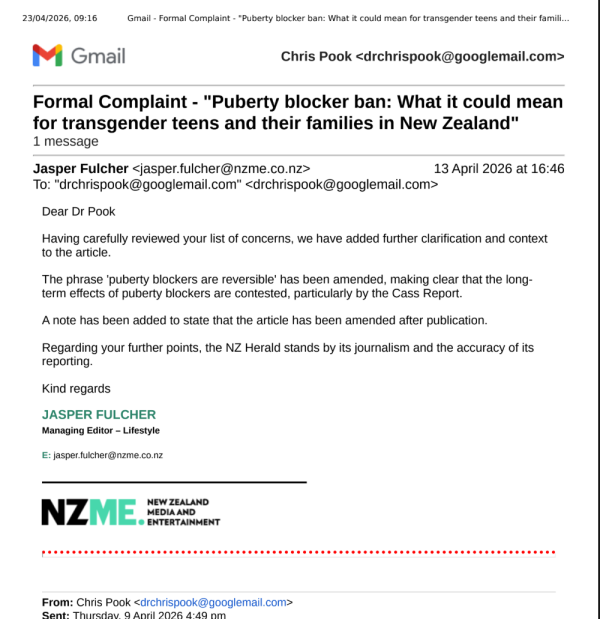
After I complained, the Herald amended the article to read: “Puberty blockers have long been thought of as fully reversible, although this was disputed by the Cass Review, which said the claim that there were no lasting negative effects was lacking evidence.” This is an improvement, but it still understates the position. The Cass Review did not merely dispute a long-standing consensus. It found that the claim was never adequately evidenced in the first place. And characterising its findings as saying that evidence for safety was “lacking” is weaker than what the Review actually found: positive evidence of harm in several domains.
The Suicidality Claim
The more serious concern involves a statement made in the article by Professor Paul Hofman, a paediatric endocrinologist at the University of Auckland. Speaking in the context of what happens to gender-dysphoric young people who do not receive puberty blockers, Professor Hofman is quoted as saying that some “self-harm” and “others become suicidal.”
This statement was published without challenge and without any reference to the evidence base. The problem is not only that the claim is not supported by the current evidence. The Cass Review concluded that “the evidence does not adequately support the claim that gender-affirming treatment reduces suicide risk”. But also that the manner in which it was published breaches New Zealand’s own guidelines on responsible reporting of suicide.
Those guidelines, which are embedded in the Government’s Suicide Prevention Action Plan 2025–2029, require that claims about suicide are evidence-based, that suicide is not attributed to a single cause, and that reporting avoids creating the impression that suicide is the expected or likely outcome in certain situations. The statement as published fails all three of these tests. It attributes suicidality to a single cause: the absence of a specific treatment, and creates the clear impression that suicide is an expected outcome for young people who do not receive that treatment.
The risks of this kind of reporting are well documented. A 2024 review commissioned by the UK Government specifically examined claims about suicidality made in public discourse about puberty blockers and found that attributing suicide to a single cause in this context was “insensitive, distressing and dangerous.” It identified the particular risk to already-distressed young people of identifying with the message that people in their situation are expected to die without a specific treatment, a dynamic that research has shown can lead to imitative harm.
The Media Council Process
The Media Council upheld the complaint in part. It accepted that the original reversibility statement was inaccurate and that the Herald’s amendment, while an improvement, did not fully resolve the concern. It did not, however, uphold the complaint on the suicidality ground, finding that the article did not “expressly assert” a causal relationship between the absence of puberty blockers and suicidality.
I have written to the Council to seek clarification on this finding. The Council’s ruling at paragraph 14 explicitly noted my reference to the Suicide Prevention Action Plan, but its reasoning on the suicidality ground made no mention of the responsible reporting framework or the evidence I submitted. My question to the Council is simple: were those materials considered, and if so, how were they weighed?
The reason I think this matters beyond the specifics of this article is that the responsible reporting guidelines exist for a reason. They are grounded in research showing that the way suicide is reported in the media affects the behaviour of vulnerable people, particularly young people. If those guidelines apply in all other contexts- and they absolutely do- they must also apply when the subject is gender dysphoria. The content of a claim does not change the reporting standards that govern how it is published.
The Documents
The following documents relating to this complaint are available below. I have not included the personal correspondence or the supporting scientific materials in this post, but I am happy to share them on request.
My original complaint to the NZ Herald and, subsequently, the Media Council:
The Herald’s initial response to my complaint:
The Herald’s formal response to the Media Council
My response to the Herald’s submission:
The Media Council’s ruling:
My request to the Media Council for clarification:


Thank you Doctor Pook for so eloquently expressing what we are all thinking but have been ignored. The article on gender is also excellent and refreshing!!
LikeLike