
“@MontereyAq: Threat of being eaten doesn’t keep adorable dumpling squid from sex, http://t.co/qJif98WPFW http://t.co/ophI5mFrKi” #krakensex
Author: drchrispook
Very proud to have been in the lab next door to the one where this was made!
(Source: https://www.youtube.com/)
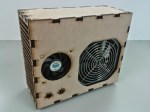
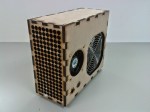


Photos of this week’s makings. A box to hold an ATX power supply which is running an extraction fan in my mass spec lab trapping HCl fumes released from a derivatisation reaction. More photos to come!
Shimadzu gas chromatographs
This is the Shimadzu GC-2010 Plus, our newest gas chromatograph:
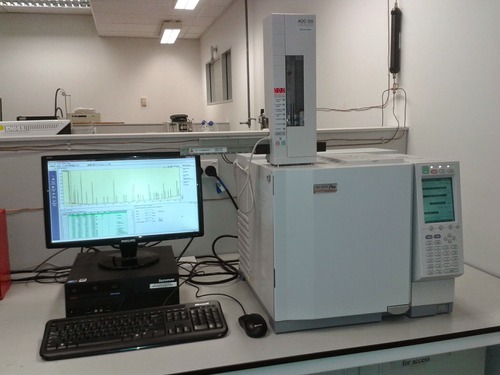
The tower mounted on top is the AOC-20i autoinjector. We also have another two GC-210s with autoinjectors and a pair of venerable GC-17As.
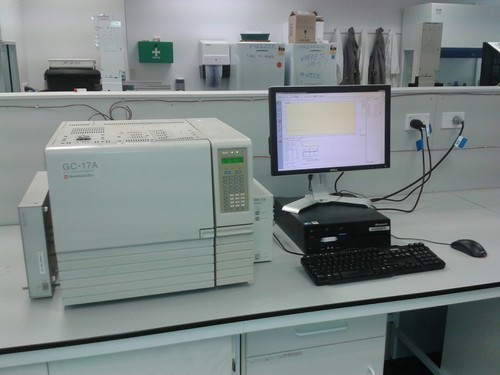
These instruments are used for quantitative analysis of small biomolecules such as fatty acids, amino acids and sugars in organisms, biofluids and food products as well as for profiling the volatile compounds associated with food flavours by Solid Phase Micro Extraction [SPME].
We have a wide range of columns to choose from but two phases that seem to separate most analytes are 5% phenyl, such as Zebron ZB-5, for less polar compounds and wax columns, such as the Zebron DB-WAX, for more polar things. The GC-2010 Plus is fitted with a Restek FAMEWAX column for Fatty Acid Methyl Ester [FAME] analysis and is routinely used to separate and quantify 36 different FAMEs.
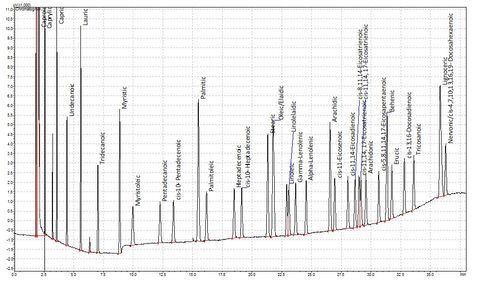
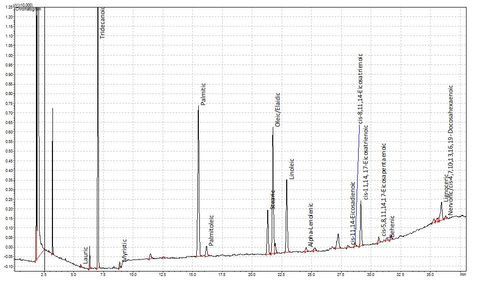
Fatty acids are not volatile in the GC and so cannot be analysed natively. A while ago though, some clever chaps realised that you could esterify fatty acids to make them volatile. This is hugely advantageous as fatty acids are not especially amenable to liquid chromatography either. This method has been refined over the years and we now use a one-tube esterification and extraction method based on de La Cruz Garcia et al (2000). The plots below show a chromatogram of a Supelco FAME standard and below that the FAMEs from a sample of human plasma. Tridecanoic acid is the internal standard.
Another application of our GCs is to analyse sugars. Sugars are even harder to analyse than fatty acids because they are so polar, they do not absorb light strongly and they are not volatile. We use the method of Blakeney et al (1983) to convert sugars from non-volatile compounds to volatile alditol acetates amenable to GC analysis. Here is a chromatogram from our GC-MS showing peaks for ten alditol acetylates in a standard mixture:
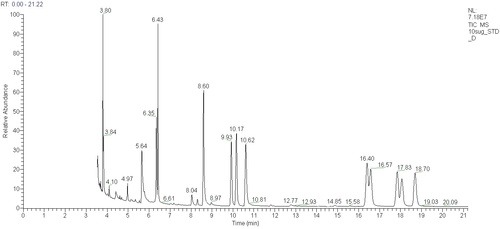
sugar and retention time (mins)
- erythritol 6.43
- rhamnose 9.93
- fucose 10.17
- xylose 10.62
- allose 16.40
- inositol 16.57
- glucose 17.83
- galactose 18.06
- mannose 18.70
References
Blakeney A.B., Harris P.J., Henry R.J., Stone B.A. (1983). A simple and rapid preparation of alditol acetates for monosaccharide analysis. Carbohydrate Research 113:2 p291–299
de La Cruz Garcia, Lopez Hernandez, Simal Lozano (2000). Gas chromatographic determination of the fatty-acid content of heat-treated green beans. Journal of Chromatography A. 891:2 p367–370
design: magazine rack
My wife keeps a large number of glossy magazines around the house which always seem to end up in piles wherever I want to put my cup of tea down. So I set about designing a rack I could laser cut out of 6mm MDF and then screw to the wall to provide my dearest with somewhere convenient yet tidy to keep them. Once I had the basic design I set about crudely baroquing it as I like pretty patterns.
😀
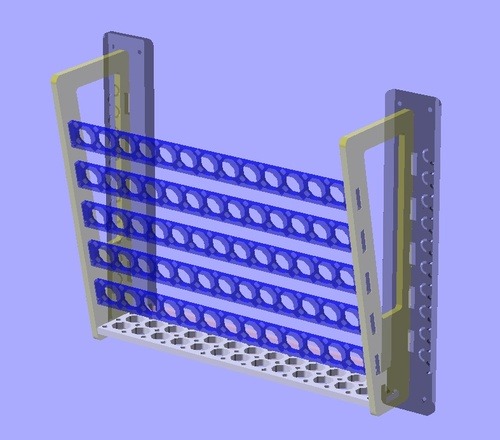
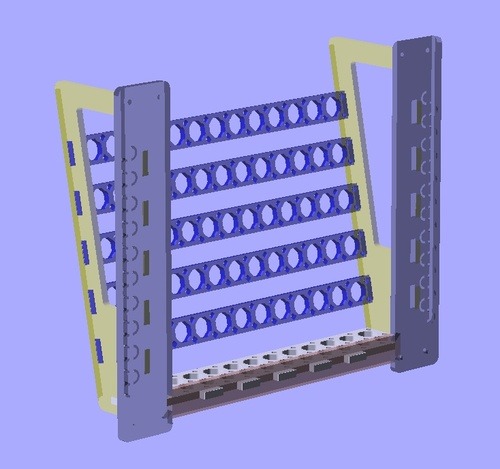
This is a single rack design which I think might be appropriate for the bathroom. I’m also going to tweak the design to add racks vertically or horizontally to house more extensive collections.
GC-MS: Thermo Trace GC Ultra – DSQ
This is our venerable single quadrupole GC-MS (Gas chromatography–mass spectrometry).
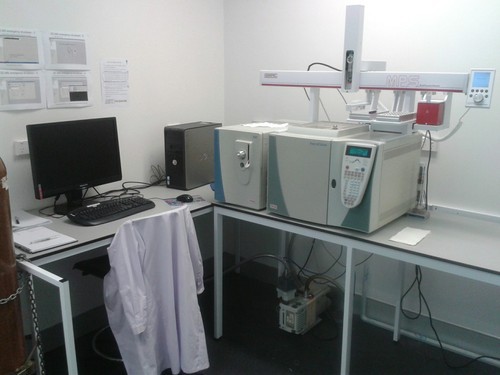
This is one of the two mass spectrometers we have, the other being the Agilent triple quadrupole LC-MS. It is a fairly standard instrument with the split/splitless injector and a 30 metre VF5-MS column. The recent acquisition of the Gerstel Multipurpose Sampler has given it an entire new lease of life, allowing us to perform sample preparation and automatic injection by headspace analysis, Solid Phase Micro Extraction (SPME) and conventional liquid injection. The instrument lives in an air-conditioned annex of my lab and is run from the PC next to it via Thermo Xcalibur v1.4 software and Gerstel’s Maestro software for the MPS.
Current applications for this instrument include a research project into the function of terpenoids in plant immune response, the analysis of sugars in a wide variety of samples by acetylation for GC, profiling of volatile compounds in seaweed and metabolite profiling by methyl chloroformate derivatisation, by the method of Smart et al (1).
(1) Smart, K. F.; Aggio, R. M. B.; VanHoutte, J. R. and Villas-Bôas, S.G. 2010. Analytical platform for metabolome analysis of microbial cells using methyl chloroformate derivatization followed by gas chromatography-mass spectrometry (GC-MS). Nature Protocols 5: 1709 – 1729. doi:10.1038/nprot.2010.108
Science, my lad, is made up of mistakes, but they are mistakes which it is useful to make, because they lead little by little to the truth
Jules Verne
Colossal squid dissection by AUT’s @ALCESonline
In all of last weeks’s electoral and laboratory drama I forgot to tweet a link to this epic happening! Check out #squidwatch or #sciencelivetepapa.
Watch Scientists Dissect Colossal Squid LIVE | IFLScience
The Museum of New Zealand Te Papa Tongarewa and Auckland University of Technology have collected a squid and are going to be examining it live on the web for everyone to see. This isn’t just some ordinary squid; this is a colossal squid, and only two specimens have ever been recovered intact. The last specimen was examined in 2008.
QToF
Its not every day that you get a phone call from a nice man who wants to sell you a $600K instrument for a fraction of that price, but that’s what happened to me yesterday. Because my Head of Research is a very, very nice man and a damn good scientist he didn’t laugh me out of the room when I casually dropped by to mention it. So I better get off Tumblr and work on the 200 or so words he asked me to write selling the idea to the Dean!
😀
 drchrispook.com